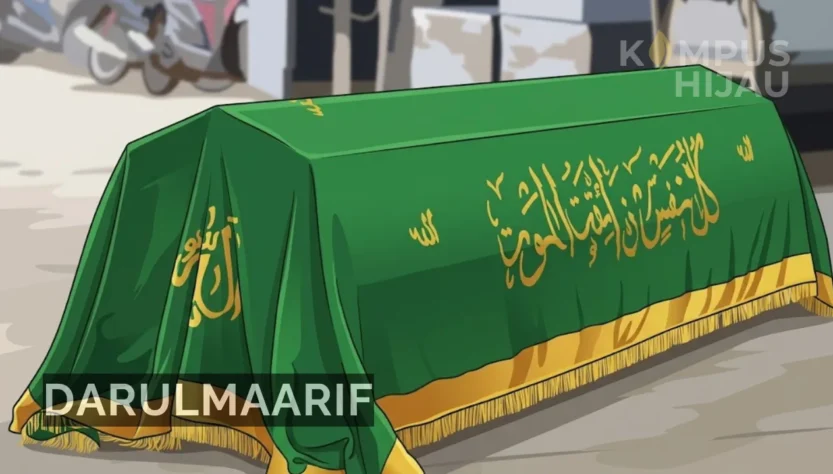
darulmaarif.net – Indramayu, 18 May 2026 | 08.00 WIB
Among Indonesian Muslim communities, the talqin tradition is often an important part of funeral processions. After the corpse is buried, usually an ustadz, kyai, or religious figure will guide the corpse with certain readings as a reminder of the answers to questions from angels in the grave.
However, in practice, quite a few questions arise in society:
“If the person who died was still a toddler, is he still on talqin?”
“What about martyrdom, do you still need talqin?”
This question seems simple, but actually touches on an important issue in corpse jurisprudence: do all corpses have the same laws regarding talqin?
In today’s digital era, questions like this are increasingly appearing on social media, Islamic study forums, and even family WhatsApp groups. Unfortunately, the answers circulating are often only snippets of opinion without a complete explanation from the ulama’s books.
In fact, in the Islamic scientific tradition, talqin law has quite clear details.
What is Talqin Mayit?
Talqin is guiding or reminding the deceased after burial with sentences of monotheism and answers to questions from the grave angel.
This tradition has long been known in the Syafi’i school of thought and is widely practiced in Islamic boarding schools and Muslim communities in the archipelago.
The aim is not because the deceased “doesn’t know”, but rather as a form of prayer, reminder and hope that Allah will give strength to the deceased when facing the slander of the grave.
Therefore, the law of talqin in the Shafi’i school of thought is sunnah for deceased Muslim Muslims.
Is it Sunnah for Little Children to Talk?
In the explanation of Syafi’iyyah scholars, children who have not reached puberty are not recommended to become taqin.
Why?
Because small children have not been exposed to the taklif of the Shari’a and have not experienced the slander of the grave like themukallaf adults.
Imam An-Nawawi in Al-Majmu’ Sharh Al-Muhadzdzab explain:
This indoctrination is only for those in charge who have died, while boys will not be taught.
This means: “This talqin only applies to corpses that aremukallaf. Meanwhile, small children are not talqin.” (Al-Majmu’, Volume 5, p. 304)
A similar explanation is also found in the book I follow Tholibin:
He comes out as a grown child, and must not teach him lest he be tempted in his grave
Meaning: “Small children are not included in this discussion. So it is not sunnah for their mentalqin, because they do not suffer the slander of the grave.” (I’anatut Tholibin, Juz 2, p. 158)
Logically, this shows that talqin is related to tests in the grave which are related to sharia responsibility. Small children do not yet have the burden of sins and religious legal obligations like adults.
Therefore, they do not need talqin like the deceased Mukullaf.
However, scholars still recommend reading the Koran and praying for children who die. Some scholars even say that it is recommended to read the Koran until the end as a form of prayer and blessing.
What about people who died as martyrs?
Then another question arises:
If martyred people have great merit in the sight of Allah SWT, do they still need to be talqined?
The majority of Shafi’iyyah scholars still recommend talqin for the martyred.
In the book Fathul Mu’in mentioned:
And (instructions to adults, even if he is a martyr) as required by their generalization – in contrast to Al-Zarkashi
Meaning: “And it is sunnah for the mentalqin of the deceased who has reached puberty, even though he is a martyr, as understood from the general explanation of the ulama. This is different from the opinion of Imam Az-Zarkasyi.”
This explanation is then explained further in I follow Tholibin:
(Proverb: Even if he is a martyr) The aim is to refute, and there is no difference between a war martyr and another person.
Meaning: “The expression ‘despite martyrdom’ is a rebuttal (to other opinions). There is no difference between war martyrdom and anything other than that.” (I’anatut Tholibin, Juz 2, p. 159)
This means that the status of martyrdom does not automatically invalidate the Sunnah of Talqin.
Indeed, there are some scholars who exclude war martyrs because they are not prayed for. However, the strong opinion among the Shafi’i school of thought still makes talqin sunnah for martyrs who have reached puberty.
This shows that a person’s glory in the sight of Allah SWT does not always erase the entire Sunnah of handling corpses.
Talqin is not just a tradition
In the midst of today’s modernity, some people are starting to question death traditions in Islam, including talqin. There are those who consider it just local culture, and quite a few even debate it on social media without understanding the roots of its fiqh literature.
In fact, talqin is not only a matter of ritual, but also a symbol of the spiritual concern of living people for those who have died.
He is a reminder that after death, humans do not carry digital positions, wealth or popularity. All that remains is faith and charity.
Therefore, the talqin tradition actually contains a very deep theological message:
that human life does not stop on earth.
In the view of the Shafi’i madzhab scholars, talqin is sunnah for Muslims who have died who have passed away, including martyrs. Meanwhile, for small children who have not yet reached puberty, talqin is not recommended because they have not been subject to the burden of the Shari’a and have not experienced the disaster of the grave like adults.
These legal differences show how detailed and logical the discussion of Islamic jurisprudence is. Each law has a clear reason, context and scientific basis in the scholarly literature.
In the midst of the flood of religious information in the digital era, the public needs to be more careful in drawing legal conclusions. Not all snippets of lectures or social media quotes are able to explain fiqh issues completely.
Therefore, the tradition of studying with scholars, reading books, and understanding the context of opinions remains an important way so that religion is not understood superficially and haphazardly.
Hope it is useful. Wallohu a’lam.
PakarPBN
A Private Blog Network (PBN) is a collection of websites that are controlled by a single individual or organization and used primarily to build backlinks to a “money site” in order to influence its ranking in search engines such as Google. The core idea behind a PBN is based on the importance of backlinks in Google’s ranking algorithm. Since Google views backlinks as signals of authority and trust, some website owners attempt to artificially create these signals through a controlled network of sites.
In a typical PBN setup, the owner acquires expired or aged domains that already have existing authority, backlinks, and history. These domains are rebuilt with new content and hosted separately, often using different IP addresses, hosting providers, themes, and ownership details to make them appear unrelated. Within the content published on these sites, links are strategically placed that point to the main website the owner wants to rank higher. By doing this, the owner attempts to pass link equity (also known as “link juice”) from the PBN sites to the target website.
The purpose of a PBN is to give the impression that the target website is naturally earning links from multiple independent sources. If done effectively, this can temporarily improve keyword rankings, increase organic visibility, and drive more traffic from search results.